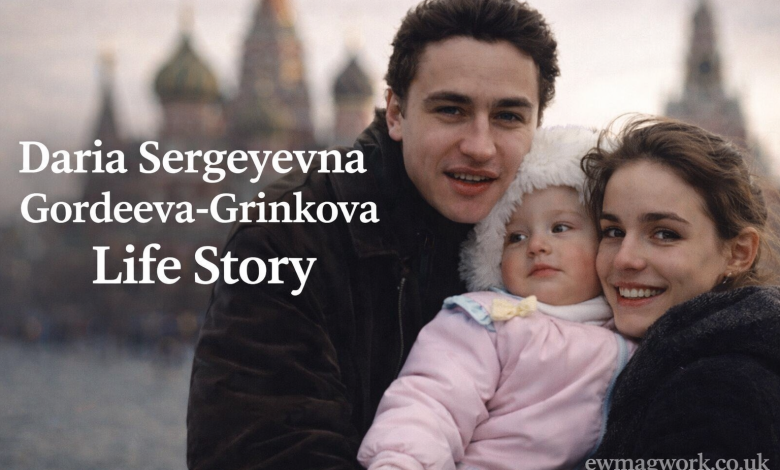
Daria Sergeyevna Gordeeva-Grinkova was born into one of the most celebrated families in the history of figure skating. Her name carries global recognition, not because of her own public achievements, but because of the extraordinary legacy of her parents. As the daughter of two Olympic champions, her life has often been viewed through the lens of history, tragedy, and expectation. Yet Daria’s story is not one of medals or podiums. It is a biography shaped by early loss, quiet resilience, and a conscious decision to live outside the glare of inherited fame.
From the outside, it may seem inevitable that she would follow the same path as her parents. In reality, her life reflects a far more nuanced journey—one that balances remembrance with independence, and public curiosity with personal privacy.
Early Life and Family Background
Daria Sergeyevna Gordeeva-Grinkova was born on September 11, 1992, in Morristown, New Jersey. Her parents, Ekaterina Gordeeva and Sergei Grinkov, were not just elite athletes; they were icons of international figure skating. Together, they redefined pairs skating with their emotional performances, technical precision, and rare on-ice harmony. By the time Daria was born, her parents were already Olympic gold medalists and global sports figures.
Despite the fame surrounding them, Daria’s earliest years were marked by relative normalcy. Her parents were known to be deeply devoted to family life, often emphasizing stability and warmth behind the scenes. Friends and colleagues later described Sergei Grinkov as a gentle and devoted father, while Ekaterina Gordeeva was known for her quiet strength and discipline.
This sense of security was abruptly shattered in November 1995, when Sergei Grinkov died suddenly at the age of 28 after collapsing during a training session. Daria was just three years old. The loss sent shockwaves through the sports world and fundamentally altered the trajectory of her life.
Growing Up After Tragedy
Losing a parent at such a young age is life-altering under any circumstances. For Daria, the experience was compounded by the public nature of her father’s death. Sergei Grinkov’s passing was widely covered by international media, and tributes poured in from athletes, fans, and organizations around the world. While Daria was too young to fully understand what had happened, the absence of her father became a defining constant.
As she grew older, her understanding of her father came largely through stories, photographs, and the memories of others. She learned about him not only as an Olympic champion, but as a man deeply loved by those who knew him personally. Being told that she resembled him, both physically and in temperament, became a recurring theme in her life.
Ekaterina Gordeeva played a central role in shaping Daria’s upbringing. In the years following Sergei’s death, she continued to skate professionally for a time, but gradually shifted her focus toward motherhood. Protecting Daria from excessive media exposure became a priority, even as public interest in the family remained strong.
Life Around Figure Skating
Given her family history, figure skating was always present in Daria’s world. She spent time in ice rinks, observed rehearsals, and was familiar with the routines of elite athletes from a young age. For a brief period, she skated recreationally and even appeared alongside her mother in a televised skating special during childhood.
However, unlike many children of famous athletes, Daria did not pursue skating as a serious competitive path. As she grew older, it became clear that the expectations attached to her surname were heavy. Many assumed she would one day replicate her parents’ success, despite the immense pressure such assumptions carried.
Daria herself later acknowledged that those expectations felt overwhelming. Rather than inspiring her, they often created a sense that her future had been prewritten by others. Over time, she began to distance herself from the idea that her identity should be defined by the sport that made her parents famous.
Choosing a Different Path
A major turning point came during her teenage years. After relocating to Southern California and enrolling at Sage Hill School, Daria made a deliberate decision to step away from figure skating altogether. Instead, she embraced a more conventional student life and found enthusiasm in team sports, particularly lacrosse.
This shift was significant. Lacrosse offered something skating never could for her: anonymity, teamwork, and freedom from constant comparison. On the field, she was not viewed as a prodigy or a legacy figure. She was simply another student learning, competing, and growing alongside her peers.
In interviews from that period, Daria spoke candidly about wanting a normal life. She expressed appreciation for her parents’ achievements while also making it clear that she did not feel obligated to replicate them. This perspective reflected a maturity beyond her years and a strong sense of self-awareness.
Education and Personal Interests
Education became an important anchor in Daria’s life. Away from the international spotlight of figure skating, she was able to explore academic and creative interests more freely. She showed curiosity in subjects related to design, communication, and storytelling, suggesting an inclination toward creative expression rather than athletic competition.
Those close to her have described her as thoughtful, reserved, and introspective. Rather than seeking attention, she appeared comfortable operating behind the scenes, valuing close relationships and personal fulfillment over public recognition. This approach stood in contrast to the world of elite sports in which she had been raised.
Relationship With Her Heritage
Although she grew up primarily in the United States, Daria maintained a connection to her Russian heritage. Her name itself reflects traditional Russian naming customs, and she has spoken fondly of visiting Russia and feeling a sense of cultural belonging there.
This dual identity—Russian by heritage, American by upbringing—added another layer to her sense of self. It allowed her to appreciate her parents’ roots while forming her own worldview shaped by different cultural influences.
Public Curiosity and Privacy
As the years passed, public information about Daria became increasingly limited. This was not accidental. Unlike many children of celebrities who embrace public platforms, Daria chose discretion. She did not cultivate a media presence or seek opportunities tied to her family’s fame.
This privacy has, paradoxically, fueled ongoing curiosity. Searches for her name often reflect a desire to know how she turned out, whether she skates, and what kind of life she leads now. Yet the absence of constant updates is itself revealing. It suggests a person who values autonomy and boundaries in a world that often ignores both.
Understanding Her Legacy
Daria Sergeyevna Gordeeva-Grinkova occupies a unique place in sports history. She is part of a story that continues to move audiences decades later, yet she has never positioned herself as a central figure in that narrative. Instead, she exists alongside it, honoring the past without being consumed by it.
Her life challenges common assumptions about legacy. It shows that being born into greatness does not require a replication of greatness in the same form. Sometimes, legacy is preserved not through continuation, but through choice—the choice to live authentically, even when expectations point elsewhere.
Conclusion
Daria Sergeyevna Gordeeva-Grinkova’s biography is not defined by public achievements or professional titles. It is defined by context, character, and restraint. Born into fame, shaped by early loss, and surrounded by expectations few could fully understand, she chose a quieter, self-directed path.
Her story resonates because it reflects a universal truth. Identity is not inherited; it is built. In choosing privacy, balance, and personal meaning over public acclaim, Daria has written a narrative that stands on its own. It is a life lived between remembrance and independence, proving that sometimes the most powerful legacy is the freedom to choose who you become.