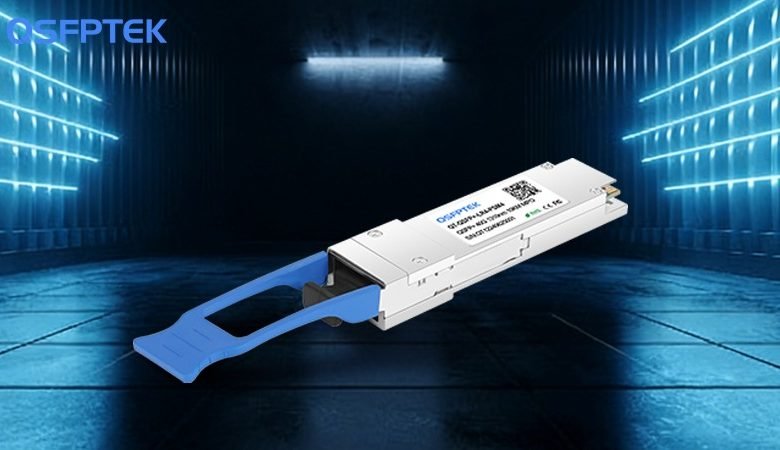
As 40G modules continue to be widely deployed in data centers and enterprise networks, many organizations are looking for practical ways to extend 40G connectivity beyond traditional short-reach links. While short-reach solutions are effective for intra–data center connections, they quickly reach their limits as networks expand across buildings, campuses, or nearby facilities. At the same time, not every deployment requires the cost and complexity of long-reach CWDM optics. In this context, 40GBASE-PSM4 QSFP+ optical modules have emerged as a balanced option, enabling reliable 40G expansion from short reach to distances of up to 10 km over single-mode fiber.
Understanding the Architecture of 40GBASE-PSM4
40GBASE-PSM4 is a parallel single-mode optical solution that transmits four independent 10 Gbps channels over four pairs of single-mode fibers. Operating at a nominal wavelength of 1310 nm, the module uses parallel optics rather than wavelength multiplexing to achieve an aggregate data rate of 40 Gbps. At the physical layer, this design requires an MTP/MPO connector with eight fibers, four for transmission and four for reception.
This parallel architecture distinguishes PSM4 from LR4 and ER4 modules, which rely on CWDM technology to multiplex multiple wavelengths onto a single fiber pair. By avoiding wavelength multiplexing, PSM4 modules simplify the optical design and reduce component complexity, while still delivering significantly longer reach than multimode solutions.
Limitations of Short-Reach 40G Solutions
Short-reach 40G modules such as 40G SR4 are optimized for intra–data center connectivity, typically supporting distances of up to 100 meters over OM3 or OM4 multimode fiber. These solutions are cost-effective and easy to deploy in high-density environments, but their reach is inherently limited. As data centers expand and network architectures evolve, short-reach optics often become insufficient for inter-row, inter-building, or campus-scale connections.
When network expansion exceeds the physical limits of multimode fiber, operators must consider alternative optical solutions. Simply extending multimode infrastructure is not feasible beyond certain distances, which makes single-mode optics a necessary step for medium-reach and long-reach deployments.
Why 40GBASE-PSM4 Fits the 10 km Expansion Gap
40GBASE-PSM4 is designed specifically to bridge the gap between short-reach and long-reach 40G optics. With support for transmission distances of up to 10 km over single-mode fiber, PSM4 enables network expansion without the complexity and cost associated with CWDM-based solutions. This makes it particularly attractive for scenarios such as data center interconnects within a campus, connections between nearby facilities, or aggregation links in enterprise networks.
Because PSM4 uses parallel optics, it maintains a relatively straightforward signal path. This simplicity can translate into predictable performance and easier troubleshooting compared to wavelength-multiplexed designs. For networks that require extended reach but do not need 40 km transmission, PSM4 offers a balanced solution that aligns more closely with actual deployment requirements.
Cabling Considerations and Infrastructure Alignment
One of the key considerations when deploying 40GBASE-PSM4 is the use of MTP/MPO cabling. Unlike duplex LC connections used by LR4 and ER4 modules, PSM4 requires parallel single-mode fiber infrastructure. While this may increase fiber count per link, it also aligns well with modern data center cabling strategies that already use MTP/MPO systems for high-density connectivity.
In environments where MTP/MPO cabling is already in place or planned for future scalability, adopting PSM4 can be a natural extension of the existing infrastructure. The consistent use of parallel optics across different speeds also simplifies migration paths, particularly when planning for future transitions to higher-speed parallel interfaces.
Cost and Complexity Trade-Offs
From a cost perspective, 40GBASE-PSM4 often sits between SR4 and ER4 solutions. While it may be more expensive than short-reach multimode modules, it is generally more cost-effective than long-reach CWDM-based optics. Additionally, by avoiding the need for complex wavelength multiplexing components, PSM4 can offer favorable cost-to-performance characteristics for medium-reach applications.
Operational complexity is another important factor. Long-reach optics may introduce stricter power budgets and increased sensitivity to dispersion, which can complicate deployment and maintenance. PSM4 modules, with their simpler optical design, provide a more straightforward operational model for networks extending beyond short reach but staying within the 10 km range.
Role of 40GBASE-PSM4 in 40G Network Evolution
In many real-world networks, 40G does not exist in isolation. Instead, it forms part of a multi-speed architecture that includes 10G, 25G, and increasingly 100G links. Within this environment, 40GBASE-PSM4 plays a transitional role, enabling extended 40G connectivity while supporting gradual network evolution.
For organizations that are not ready to migrate entirely to 100G, PSM4 allows continued investment in 40G infrastructure without sacrificing flexibility or reach. It supports incremental expansion strategies that align technical upgrades with business timelines, rather than forcing premature adoption of higher-speed technologies.
When PSM4 Is the Right Choice
Choosing 40GBASE-PSM4 makes the most sense in scenarios where network distances exceed the limits of multimode fiber but do not justify the deployment of long-reach CWDM optics. It is particularly well suited for data center campuses, metro-edge environments, and enterprise backbones that require reliable 40G links over several kilometers.
By combining extended reach, architectural simplicity, and compatibility with parallel fiber systems, PSM4 addresses a specific but common set of deployment needs. It is not intended to replace all other 40G solutions, but rather to complement them within a well-designed optical strategy.
Conclusion
40GBASE-PSM4 QSFP+ optical modules provide a compelling option for extending 40G networks from short-reach environments to distances of up to 10 km. By leveraging parallel single-mode optics and MTP/MPO cabling, PSM4 delivers a practical balance between reach, cost, and complexity. For organizations looking to expand 40G connectivity without overengineering their network, PSM4 remains a smart and relevant choice in modern 40G deployments.