Commercial aviation runs on routine. Flights depart on schedule, climb to cruising altitude, and land with practiced precision. Yet every so often, that rhythm shifts. An announcement comes from the cockpit. The aircraft changes direction. The word “emergency” enters the cabin vocabulary.
That is what happened with Delta Connection flight DL3543, an incident that quickly drew attention online after the aircraft declared an emergency and returned to Minneapolis shortly after takeoff. For passengers on board, the experience likely felt tense and uncertain. For aviation professionals, however, it was a familiar scenario: identify a potential issue early, prioritize safety, and bring the aircraft back under controlled conditions.
The delta connection dl3543 emergency landing was not defined by chaos or catastrophe. Instead, it offers a revealing look at how modern airline safety systems operate in real time.
What Happened on Flight DL3543
Flight DL3543 departed from Minneapolis–Saint Paul International Airport on a routine regional route. Not long after takeoff, while the aircraft was still climbing, the crew stopped the ascent and made the decision to return to the departure airport. Reports indicate the aircraft had reached approximately 21,000 feet before leveling off and turning back.
Air traffic control was notified of the situation, and the crew declared an emergency. That declaration ensured priority handling in the airspace and coordination with airport ground services. Within a short time, the aircraft landed safely back in Minneapolis.
Importantly, there were no reports of injuries. There was no crash landing. The aircraft touched down under control, and passengers were able to deplane normally.
In aviation terms, that sequence is not a failure. It is a controlled outcome.
Understanding What an Emergency Declaration Really Means
The term “emergency landing” often triggers dramatic imagery. In reality, an emergency declaration is a procedural tool. It signals that the flight crew requires immediate priority and additional support from air traffic control.
Pilots are trained to declare emergencies conservatively. If a system warning appears, if an unusual indication arises, or if a technical irregularity is detected, the safest course of action is often to treat it as urgent until proven otherwise. Waiting can increase risk. Acting early reduces it.
When a crew declares an emergency, several things happen simultaneously. Air traffic controllers clear surrounding traffic to give the aircraft space. Airport fire and rescue teams prepare as a precaution. Airline dispatch teams coordinate on the ground. Each layer of the system moves into alignment.
Passengers may only hear a calm announcement. Behind the scenes, a well-rehearsed chain of response unfolds.
Why Returning to the Departure Airport Is Often the Smart Choice
One of the most common questions after incidents like DL3543 is simple: why turn back instead of continuing to the destination?
The answer usually comes down to control and familiarity.
The departure airport is known territory. The crew has just taken off from it. Weather conditions are current. Runway configurations are understood. Ground maintenance resources are readily available. If an aircraft is still relatively close, returning eliminates unknowns.
Regional flights, in particular, often operate on shorter routes. That means fuel loads and weight profiles can make a return both feasible and efficient. Rather than pressing on and increasing distance from support services, crews frequently choose the most direct route back to a fully equipped hub.
In the case of DL3543, the decision to return shortly after departure suggests the crew prioritized caution over convenience. That approach reflects industry best practice.
The Aircraft and Operational Context
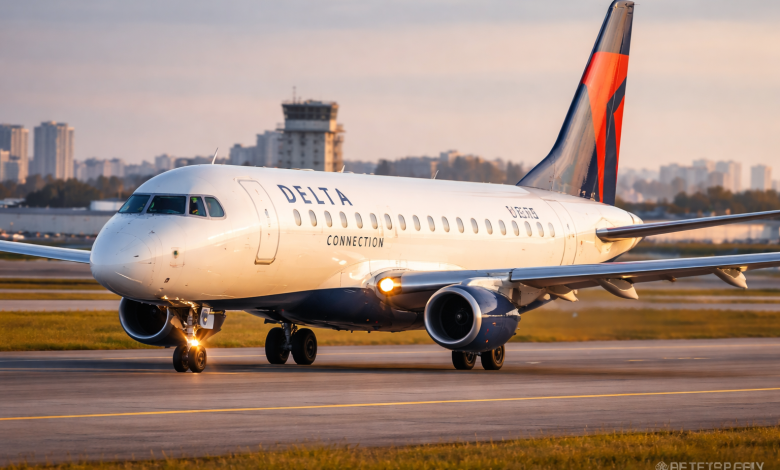
Delta Connection flights are typically operated by regional partner airlines under the Delta brand. These flights often use aircraft such as the Embraer E175, a widely deployed regional jet known for efficiency and passenger comfort.
The E175 is designed with multiple redundancies and advanced onboard monitoring systems. Modern aircraft continuously analyze engine performance, pressurization, hydraulics, and electrical systems. When something falls outside normal parameters, cockpit alerts notify the crew immediately.
Those alerts do not necessarily indicate imminent danger. Often, they indicate caution. The aircraft may still be fully controllable and stable, yet the presence of an unexpected warning prompts a review of checklists and, in some cases, a return to base.
In this context, the DL3543 emergency landing likely reflects the effectiveness of early detection rather than the failure of a major system.
Passenger Experience: Calm in the Cabin, Coordination Behind the Scenes
For travelers, the emotional experience can differ sharply from the operational reality.
A turn back to the airport can feel sudden. A change in engine power or flight path may raise concern. Even a measured announcement from the cockpit can heighten tension. Human psychology fills in the blanks when information is limited.
Yet commercial airline crews train repeatedly for such events. Pilots practice abnormal procedures in high-fidelity simulators. Flight attendants rehearse emergency readiness and cabin management protocols. These scenarios are not improvised. They are standardized.
When emergency vehicles line the runway during landing, passengers may interpret that as a sign of danger. In fact, it is precautionary. Airport response teams position themselves as part of established safety procedures. Their presence ensures rapid action if needed. In many cases, they never intervene beyond observation.
That layered approach is what allows most emergency returns to conclude without incident.
The Bigger Picture: Aviation Safety Trends
It is easy to assume that increased visibility of flight incidents means flying is becoming less safe. The data suggests otherwise.
Global aviation safety organizations continue to report historically low accident rates. Over the past decade, commercial air travel has maintained one of the safest transportation records in history. Improvements in aircraft technology, crew training, and real-time data monitoring have reduced fatal accident risk significantly.
At the same time, public awareness has grown. Flight-tracking apps allow anyone to observe altitude changes and emergency codes in real time. Social media platforms amplify alerts within minutes. As a result, routine emergency declarations that once passed quietly through operational channels now circulate widely online.
Greater transparency does not equate to greater danger. In many ways, it highlights the system’s responsiveness.
Why Early Action Defines Modern Airline Culture
Aviation has evolved around one core principle: act before a problem escalates.
In earlier decades of flight history, accidents often stemmed from delayed decisions or incomplete information. Today, the culture encourages crews to err on the side of caution. Declaring an emergency is not viewed as overreacting. It is viewed as exercising professional judgment.
Airlines support that mindset. Dispatch teams collaborate with cockpit crews. Maintenance departments analyze data quickly. Regulators review procedures continuously. Each layer contributes to a safety ecosystem designed to prevent small anomalies from becoming serious threats.
The DL3543 event reflects that philosophy. A possible irregularity was identified. The crew acted promptly. The aircraft landed safely. The system functioned as intended.
Public Perception Versus Operational Reality
Headlines often compress complex aviation decisions into a few dramatic words. “Emergency landing” attracts attention. It suggests urgency, perhaps even crisis.
Operationally, however, emergency landings are not rare. Airlines conduct thousands of flights daily. Among them, a small percentage will declare emergencies for mechanical indications, weather diversions, or medical issues. The vast majority end without injury.
The difference between perception and reality can shape public confidence. When events are viewed in context, they reinforce rather than undermine trust in commercial aviation.
What Travelers Should Take Away
For passengers who followed the delta connection dl3543 emergency landing story, the most important conclusion may be reassurance.
Modern aircraft are built with redundancy. Crews are trained for anomalies. Air traffic control systems provide immediate support. Airports prepare for contingencies even when they are unlikely.
An emergency declaration does not mean disaster is imminent. It means the safety net has been activated.
Understanding that distinction can transform fear into informed confidence.
Read Also: kl7cjnsb8fb162068: Understanding a Modern Digital Identifier
Conclusion
The delta connection dl3543 emergency landing serves as a reminder that aviation safety is not measured by the absence of warnings, but by how effectively those warnings are handled.
In this case, a flight encountered an issue shortly after departure. The crew chose caution. They declared an emergency, coordinated with controllers, and returned to Minneapolis. The aircraft landed safely, and passengers disembarked without injury.
Far from signaling systemic weakness, the event demonstrates disciplined professionalism. It highlights a safety culture built on early detection, decisive action, and layered support.
Air travel remains one of the safest forms of transportation available. Incidents like DL3543 do not contradict that reality. They quietly confirm it.