Electric vehicle ownership changes how drivers think about energy. Instead of glancing at a fuel gauge and shrugging, EV drivers actively think about range, efficiency, and how their choices affect battery usage. For Cadillac LYRIQ owners, one of the most common and reasonable questions is whether the vehicle’s driving modes actually change how far the SUV can go on a single charge.
At first glance, the answer seems simple. The battery is the battery. Its size does not change when you tap Sport or Tour on the screen. Yet real-world experience often tells a different story. Drivers notice the range estimate dropping faster in some modes than others. They feel the car behaving differently, responding more eagerly or more calmly, and they naturally wonder whether those differences come at an energy cost.
The truth sits somewhere between myth and mechanics. Cadillac LYRIQ driving modes do not magically unlock extra miles, but they can influence how efficiently the vehicle uses its stored energy. Understanding how and why that happens can help drivers make smarter decisions, especially on longer trips or in challenging weather.
Understanding What “Range” Really Means in an Electric Vehicle
Before diving into driving modes, it is important to understand what range actually represents. The range number shown on the dashboard is not a fixed promise. It is an estimate based on recent driving behavior, temperature, terrain, and energy consumption patterns.
In simple terms, range is the result of two factors. The first is how much usable energy is stored in the battery. The second is how quickly the vehicle uses that energy. Driving modes do not change the first factor. The Cadillac LYRIQ’s battery capacity remains the same regardless of whether you are in Tour, Sport, Snow, or a custom My Mode. What driving modes can affect is the second factor, which is how much energy is consumed per mile.
That distinction is critical. When drivers say a mode “reduces range,” what they are usually experiencing is higher energy consumption due to the way the vehicle responds to inputs, not a reduction in the battery’s actual capacity.These practical aspects of efficiency and everyday usability also play a role when drivers consider broader EV ownership options, including accessing a vehicle through an electric car scheme, which can make advanced models like the Lyriq more convenient and financially manageable for many drivers.
How Driving Modes Work in the Cadillac LYRIQ
Cadillac designed the LYRIQ’s driving modes to adjust how the vehicle feels and responds rather than to fundamentally change its efficiency targets. Each mode fine-tunes several systems at once, including accelerator response, traction control behavior, steering feel, and overall vehicle dynamics.
These adjustments subtly influence driver behavior. A more relaxed accelerator encourages smoother driving, while a sharper response invites quicker acceleration. Over time, those differences can add up in terms of energy usage, even if the underlying hardware remains unchanged.
Tour Mode: Balanced and Naturally Efficient
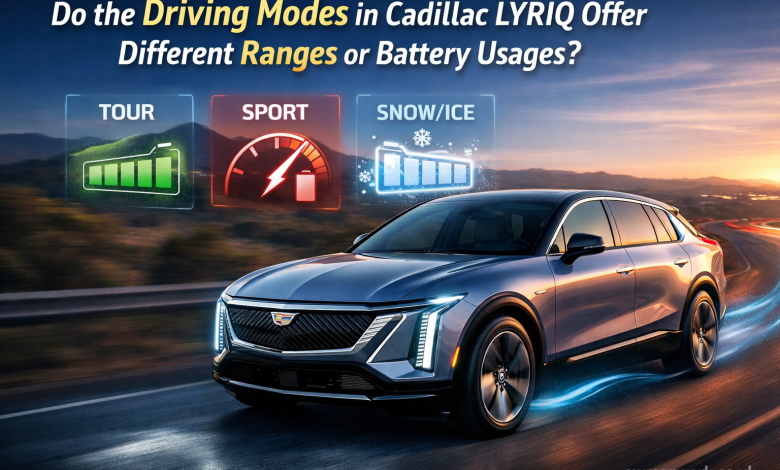
Tour mode is the default setting for many LYRIQ drivers, and for good reason. It is designed to deliver a smooth, comfortable experience that fits everyday driving. Acceleration is progressive rather than aggressive, making it easier to maintain steady speeds and avoid unnecessary bursts of power.
From an efficiency standpoint, Tour mode often produces the most consistent real-world range. The vehicle feels predictable, and the power delivery makes it easier to drive smoothly without thinking about it. For commuting, highway cruising, and longer trips, Tour mode naturally aligns with efficient driving habits.
Importantly, Tour mode does not restrict power. The LYRIQ still has access to its full performance potential when needed. The difference lies in how quickly that power arrives in response to pedal input. That calmer response helps reduce energy spikes that can quietly erode range.
Sport Mode: Performance First, Efficiency Second
Sport mode changes the LYRIQ’s personality in noticeable ways. Throttle response becomes sharper, steering feels more direct, and the vehicle feels more eager overall. For many drivers, this mode highlights how quick and capable the electric powertrain really is.
From a battery usage perspective, Sport mode does not automatically drain energy faster. If a driver maintains the same speeds and accelerates just as gently as they would in Tour mode, the difference in efficiency can be minimal. The challenge is human nature. Sport mode makes rapid acceleration easier and more tempting, and those bursts of power require significantly more energy.
Electric motors are highly efficient, but physics still applies. Accelerating a heavy luxury SUV quickly takes more energy than easing up to speed. Over the course of a drive, repeated quick launches can meaningfully reduce range. As a result, many drivers notice lower real-world range in Sport mode, not because the mode itself wastes energy, but because it encourages behavior that does.
Snow and Ice Mode: Control Over Conditions, Not Range Optimization
Snow and Ice mode is designed for safety and stability, not for maximizing range. In this mode, the LYRIQ softens accelerator response and adjusts traction control systems to reduce wheel slip on low-grip surfaces. This makes the vehicle easier to manage in winter conditions or on slick roads.
In theory, smoother torque delivery can help prevent wasted energy from wheelspin. In practice, however, winter driving almost always reduces range regardless of mode. Cold temperatures affect battery chemistry, increasing internal resistance and reducing available energy. At the same time, cabin heating demands draw additional power from the battery.
Because of these factors, drivers often associate Snow and Ice mode with lower range. The reality is that the conditions prompting the use of this mode are the main cause of the reduction. Snow and Ice mode prioritizes stability and predictability, which can indirectly support efficiency, but it cannot overcome the fundamental challenges of cold weather driving.
My Mode: Customization and the Opportunity for Smarter Efficiency
My Mode is one of the LYRIQ’s most underrated features. It allows drivers to personalize how the vehicle responds in areas such as acceleration feel, steering effort, and braking characteristics. This customization makes it possible to create a driving experience that balances comfort, responsiveness, and efficiency.
For drivers focused on range, My Mode can be configured to soften accelerator response while keeping steering feel and other preferences intact. This reduces the likelihood of unintentional energy spikes without making the vehicle feel dull or disconnected. In daily driving, this tailored approach can be more effective than relying solely on preset modes.
My Mode highlights an important truth about EV efficiency. The most effective strategy is not forcing yourself into a single predefined setting, but aligning the vehicle’s behavior with how you actually drive.
The Role of Regenerative Braking in Battery Usage
Driving modes are only part of the energy story. Regenerative braking plays a major role in how efficiently the LYRIQ uses its battery, particularly in city driving. When the vehicle slows down using regenerative braking, kinetic energy is converted back into electrical energy and stored in the battery.
The LYRIQ offers features such as One-Pedal Driving and Regen on Demand, which allow drivers to maximize energy recovery during deceleration. Used thoughtfully, these systems can improve efficiency by reducing reliance on friction brakes and capturing energy that would otherwise be lost as heat.
However, regenerative braking has limits. When the battery is near full or very cold, the system may reduce regen capability to protect the battery. In those situations, driving style becomes even more important, as opportunities to recover energy are reduced.
Why Real-World Range Varies So Widely
Many drivers are surprised by how much their range can change from one day to the next. Driving modes contribute to this variability, but they are rarely the dominant factor. Speed, wind, elevation changes, tire choice, temperature, and climate control usage often have a much larger impact.
For example, highway driving at higher speeds dramatically increases aerodynamic drag, which rises exponentially with speed. This alone can reduce range far more than switching from Tour to Sport mode. Similarly, running cabin heat in cold weather can consume several kilowatts continuously, shortening range regardless of driving mode.
Understanding this broader context helps put driving modes in perspective. They shape the driving experience and influence habits, but they operate within a much larger efficiency ecosystem.
Choosing the Right Mode for Your Driving Needs
The best driving mode depends on your priorities for a given trip. Tour mode is well suited for long drives and everyday efficiency. Sport mode makes sense when responsiveness and enjoyment take precedence over maximum range. Snow and Ice mode is essential for maintaining control in hazardous conditions, even if range is reduced by the environment itself. My Mode offers the flexibility to fine-tune the balance between these goals.
Rather than searching for a single mode that guarantees maximum range, drivers are better served by understanding how each mode influences behavior and energy use. Small adjustments in acceleration habits and speed often deliver greater range benefits than mode changes alone.
Conclusion
So, do the driving modes in the Cadillac LYRIQ offer different ranges or battery usages? The most accurate answer is that they can, but indirectly. Driving modes do not change the battery’s capacity or unlock hidden miles. What they do change is how the vehicle responds, and that response shapes how drivers use energy.
Tour mode naturally supports efficient driving through smooth, predictable behavior. Sport mode emphasizes performance and can lead to higher energy consumption if used enthusiastically. Snow and Ice mode prioritizes safety in conditions that already challenge range. My Mode provides a powerful opportunity to align the vehicle’s behavior with personal efficiency goals.
Ultimately, the biggest determinants of range are not the names of the modes on the screen, but the choices made behind the wheel. Understanding how driving modes influence those choices allows LYRIQ owners to enjoy their vehicle’s versatility while making the most of every charge.